Short answer: most small businesses should start with an off-the-shelf CRM, and a smaller group genuinely needs a custom one. If your sales process looks like most other companies' (lead comes in, you call, you send a quote, you follow up), a ready-made tool at ₹500 to ₹2,000 per user per month will serve you well for years. If your process is odd, tied to your own pricing rules, inventory or field staff, and you keep bending a standard tool until it squeaks, that is when custom starts to pay for itself.
We build custom CRMs and HRMS systems, so you might expect us to push custom every time. We don't. A good half of the first conversations we have end with "use Zoho or something similar for now". Here is how we reason about it.
What "off-the-shelf" really gets you
Tools like Zoho CRM, HubSpot, Freshsales or Bitrix24 are built for the average business. That is both their strength and their limit. You sign up, import a spreadsheet of contacts, and you are running by the afternoon. Reports, email integration, mobile apps and basic automation already exist, and someone else fixes the bugs.
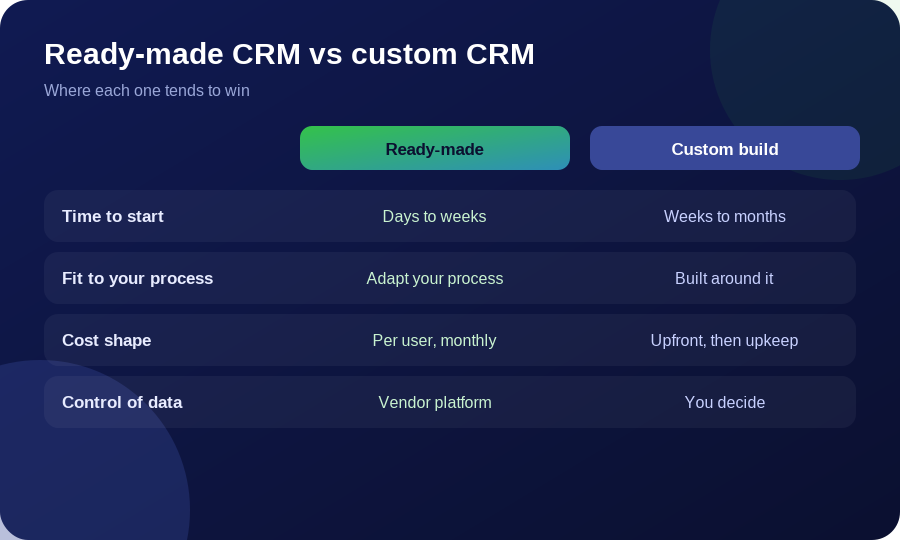
The catch is the per-user pricing, which creeps. Ten users at ₹1,500 a month is ₹15,000 a month, or ₹1,80,000 a year, before add-ons and GST. Many Indian SMEs start on a free or cheap tier and discover that the one feature they need, say workflow rules or custom fields beyond a limit, sits two plans higher.
Data is the other quiet issue. Your customer list sits on someone else's servers, sometimes abroad, and exporting it cleanly after three years is less pleasant than the sales page suggested.
What a custom CRM is good at
Custom software does exactly what your business does, no more. That sounds obvious until you see what it means in practice.
Imagine a Nashik garment wholesaler with 40 agents across Maharashtra. Orders come in over WhatsApp, prices change by customer slab, credit limits matter, and GST invoices must follow a specific format. A standard CRM can hold contacts, but it will not know that Customer A gets 6% off above fifty pieces unless they are 30 days overdue. You can fake that with spreadsheets sitting beside the CRM. Eventually you are running two systems and nobody trusts either.
A custom build can wire the pricing, credit check, invoice and WhatsApp message into one flow. It can also use your words for things. Staff learn faster when the screen says "Dealer" and not "Account".
Cost, honestly
Off-the-shelf: low entry cost, ongoing subscription, price rises with headcount. Custom: higher upfront cost, lower ongoing cost, price rises with complexity.
For a rough planning range, a focused custom CRM for a small team typically costs somewhere between ₹3,00,000 and ₹12,00,000 depending on modules, integrations and how much needs migrating. Hosting and maintenance usually add a modest yearly amount. These figures vary a lot, and anyone quoting you a fixed number after a ten-minute call is guessing.
The break-even is simple to estimate. If a ready-made tool would cost you ₹3,00,000 a year at your size and you would still pay extra for workarounds, a ₹6,00,000 build starts to look reasonable around year two. If the subscription is ₹30,000 a year, it never will.
Signs you have outgrown the ready-made option
A few patterns we see repeatedly.
- Staff keep a side spreadsheet "because the CRM can't do this".
- You pay for five tools that don't talk to each other, and someone copies data between them daily.
- Your pricing, approvals or commissions have rules that no dropdown can express.
- You need field staff on patchy 4G to work offline and sync later.
- Compliance or client contracts require data to stay on a server you control.
One or two of these is normal. Four of them is a signal.
The middle path nobody advertises
There is a third option that often gets overlooked: take a ready-made CRM and extend it. Zoho, for example, has scripting and APIs, and a developer can add custom modules, a WhatsApp connector or a GST invoice generator on top. You get the stable core and your own twist.
We often recommend this to businesses that are unsure. It is cheaper than building from scratch, it is reversible, and it teaches you what you truly need. After a year of using a standard tool you will know which five features matter. That knowledge is worth more than any requirements document you could write on day one.
Mistakes that sink both options
Most failed CRM projects are not technology failures. They are people failures.
Nobody owns it. A CRM without one person responsible for data quality fills with junk in three months. Pick an owner.
Too many fields. Sales staff will not fill in 30 fields after a long day on the road. Ask for six and make them count.
No habit. If the manager still asks for updates on WhatsApp, the team will keep sending WhatsApp. The CRM must become the place where the truth lives, and leadership has to behave that way.
Building before understanding. With custom work especially, we would rather spend two weeks sitting with your team, watching how a lead actually moves, than start coding off a feature list. Feature lists are written by people imagining the process. Watching shows the real one.
A quick way to decide
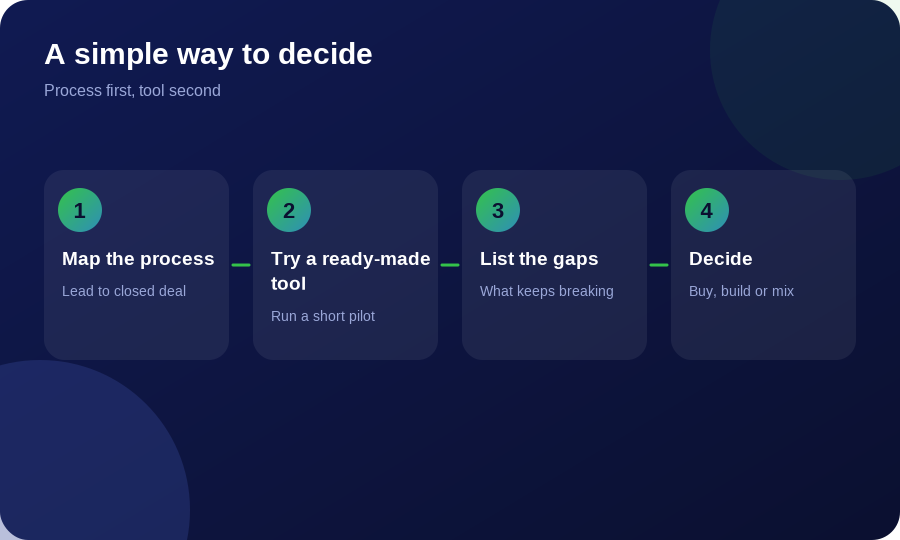
Try this over a weekend. Write down your sales or service process in plain steps, as it happens today. Then try to set it up in the free trial of a ready-made CRM. If you manage 80% without ugly hacks, buy the subscription and move on. If you hit a wall at step three and it is a wall you care about, note exactly where. That note becomes the beginning of a custom brief, and a much better one than "we want a CRM".
Also consider where you will be in three years. If you expect to double your team, per-user pricing grows with you, and custom may be cheaper then even if it is not now. If you are a five-person firm that will stay five, ready-made nearly always wins.
Our honest take
Do not build custom software to feel professional. Build it when a standard tool is costing you money or speed in a way you can point to. And do not stay on a cheap tool out of habit once it is holding your team back.
Ariess builds custom CRM and HRMS systems, and we are also fine telling you when you don't need one. If you want a candid look at your process and a rough estimate, you can write to us at ariess.in/contact.php.
Reviewed by Nitin Madhukar More, founder. Ariess builds websites, software, apps and digital marketing for growing businesses in India.